Scope
What we convert
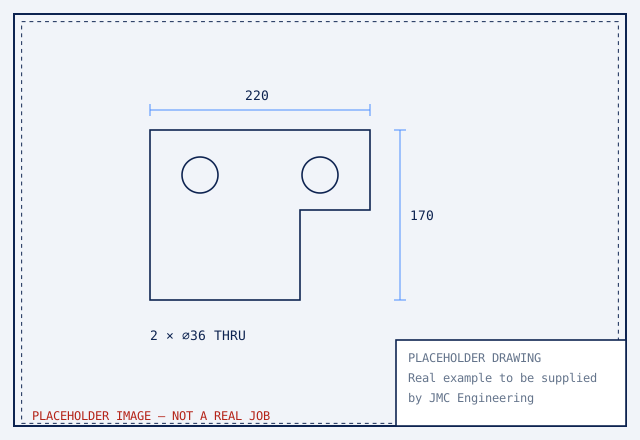
- Sheet-metal brackets and stampings — bends, reliefs, forms and the developed blank
- Machined parts — turned and milled components, including threaded and bored features
- JIS-style ordinate-dimensioned drawings, where everything is called from one datum rather than chained
- Indian automotive supplier drawings, including redrawn and rescanned prints that have been round the supply chain a few times
Deliverables
What you get
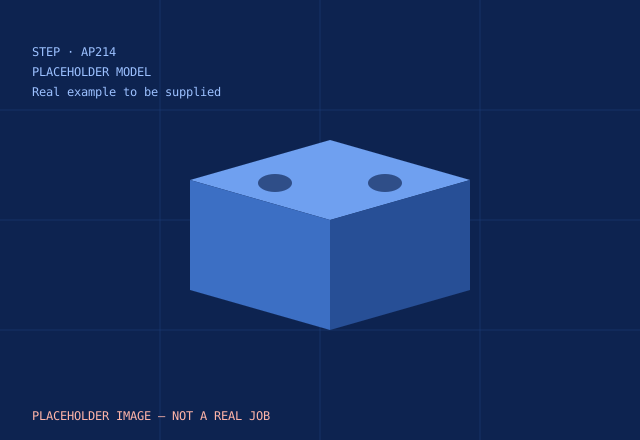
| Part STEP file | One per part, built to the dimensions on your drawing |
|---|---|
| Assembly STEP | Where the drawing is an assembly, with the parts positioned |
| Flat-pattern DXF | For sheet-metal parts — the developed blank, ready for laser or wire-cut |
| Conversion report | Everything that could not be fully modelled, and every assumption we made |
The report is the part people do not expect. A drawing that converts cleanly needs one line; a drawing with a missing section view and a note referring to a part number nobody has needs a paragraph. Either way you know what you are looking at before it reaches your machine.
Process
How it works
- Send the drawingUse the form below, a shared link, or email it to info@jmcengg.com. Tell us the part type and when you need it.
- We convert and checkThe model is built from your dimensions, then checked by a tooling engineer against the original drawing.
- You review the STEP and the reportYou get the files and a plain list of anything we could not fully model, with the assumptions we made.
- Revisions if neededIf we have read something wrong, we fix it. A change to the drawing itself is a new revision, and we will say so first.
Pricing
Quoted per drawing, on enquiry
Every drawing is different, so the price is too. Send one and you get a figure back with the quotation — not a rate card you have to work out for yourself.
What moves it: a simple part with one or two clean views prices differently from a multi-bend bracket on an ordinate-dimensioned print, which in turn prices differently from an assembly or a degraded scan where geometry has to be reconstructed rather than read.
Rush delivery is available when the quotation is due before the standard 2–3 working days is up — say so on the enquiry and we will price it with the job. Bulk pricing applies from twenty drawings a month; tell us the volume and the mix of part types and we will quote the batch rather than each print.
Trial
First three drawings free
Try it before you commit anything
New business customers get their first three drawings converted free — the same STEP files, flat-pattern DXF and conversion report as a paid job, so you are judging the real thing rather than a sample we chose.
One set per company. Send a drawing that actually matters to you; an easy one proves nothing to either of us.
Confidentiality
Your drawings stay yours
Drawings are handled under NDA on request — ask before you send anything and we will have it signed first.
A drawing you send is used only for your job. It is not shown to anyone else, and it is not used as an example on this website or anywhere else without your written permission.
Please note. A converted model is built from the drawing you supply. The customer remains responsible for verifying critical dimensions and tolerances against the original drawing before manufacture. Where a drawing is ambiguous, our conversion report says so — but the final check before cutting metal is yours.
Questions
Common questions
What file formats do you accept?
PDF, TIF, PNG and JPG for the drawing. A clean PDF export gives the best result because the linework stays sharp; a photograph of a print on a desk is usable but slower to work from. If you also have a DXF or an older STEP file, send it — it saves time and we will say so in the quotation.
How long does a conversion take?
Standard turnaround is 2–3 working days per drawing from the point we have everything we need. Rush delivery is available as an add-on. A batch of twenty is not twenty times slower — tell us the volume and we will give you a date rather than a formula.
How accurate is the model, and what if something is wrong?
The model is built to the dimensions called out on your drawing, and checked by a tooling engineer before it goes back to you. Revisions against the original drawing are included — if we have read a dimension wrong, that is ours to fix. A change to the drawing itself is a new revision and we will say so before starting it.
What happens if a drawing cannot be fully modelled?
It goes in the conversion report. Drawings have missing views, unreadable scans, contradictory dimensions and features called out only in a note. Where we have had to make an assumption, the report says which feature, what we assumed and why, so you can check that one thing instead of re-checking the whole model. Nothing is hidden and nothing is guessed silently.
Will you sign an NDA?
Yes, on request, before you send anything. Drawings are used only for your job.
Do you offer bulk pricing?
Yes, for twenty or more drawings a month. Tell us the expected monthly volume and the mix of part types and we will quote a rate for the batch rather than per drawing.
Send a drawing